Smoking Rules and Regulations in Assisted Living Facilities: The Debate

Summary: What is the smoking policy at your assisted living facility, or a facility that you are considering? If you are a smoker, or a non-smoker, understanding a facility’s rules, as well as any state regulations will help to avoid conflicts with the facility management, and other residents. Smoking rules and regulations affect the health of both smokers, and non-smokers in a variety of ways. Make sure to get a facility’s smoking policy in writing before signing an agreement or contract, and remember that rules mean nothing if there is no enforcement!
I have a pretty hard-lined stance when it comes to smoking. My belief is that if the smoke from a cigarette has any chance of coming in contact with a non-smoker, then is should be against the law in that particular place. Smokers should only be able to smoke, in my view, in their own, controlled environment, where there are no other non-smokers present. I am an ex-smoker (19 years), so I feel comfortable being a little preachy about this. Let’s face it, smoking is a terrible addiction, and first and second-hand smoke can kill.
800-307-2172Pricing & Availability
Get Pricing
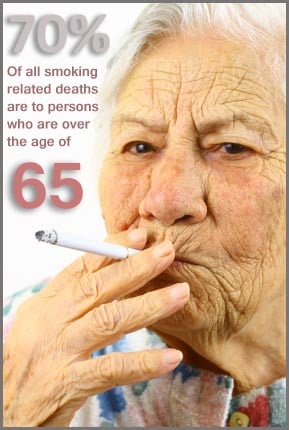
Some frightening statistics from the American Cancer Society’s page on Secondhand Smoke:
Secondhand smoke can cause harm in many ways. Each year in the United States alone, it is responsible for:
* An estimated 46,000 deaths from heart disease in people who are current non-smokers
* About 3,400 nonsmoking adults die of lung cancer as a result of breathing SHS
* Worse asthma and asthma -related problems in up to 1 million asthmatic children
* Between 150,000 and 300,000 lower respiratory tract infections in children under 18 months of age, and lung infections resulting in 7,500 to 15,000 hospitalizations each year
I know that a 100% nationwide ban on smoking indoors is an impossibility in our society (right now, at least), but I do believe that we have made some progress. Many restaurants, public areas, and health facilities have had smoking within their walls banned by state regulations, and I think this is a huge win. I must admit that I get a little tingle of satisfaction when I see a group of smokers huddled in the cold outside a bar or restaurant to get their fix.
Restaurant and bar-scene aside, I get even more serious when it comes to children and the elderly. We’ve all seen the mother or father driving around in a car with the windows closed, sucking on a cigarette with kids strapped in the back. Angry, boiling mad, and furious – emotions that I quickly feel when I see this.
However, I would guess that most of us have not witnessed an elderly person, living in an assisted living facility or nursing home, suffering from Emphysema, unable to escape the haze of smoke produced by other residents, or even the employees at the facility.
Yes, it happens, and I’d say these folks are the most helpless to do anything about it. They’ve probably signed a lease, or a contract at the facility, coupled with a possible movement disorder or other handicap, with the added touch of possible dementia or Alzheimer’s rendering them incapable of clearly speaking their mind, or expressing their desire to move, or ability to complain. Even if there is a non-smoking policy at the facility, I’d say it is a safe bet that most residents (especially those in a memory-care environment) don’t know, or understand the rules of the facility. Those details were probably quickly glanced over by a family member sometime in the past, and have been long forgotten.
“Of the over 416,000 smoking-related deaths annually in the U.S., over 94% are to persons aged 50 and over, while over 70% are to persons aged 65 and over. All the major causes of death among the elderly (cancer, heart disease, and stroke) are associated with smoking or environmental tobacco smoke. Recent research also indicates that smoking is related to a number of health problems and diseases that are generally associated with aging, including hearing loss, dementia, and Alzheimer’s.” (Source: The Center for Social Gerontology).
Unfortunately, as assisted living is largely regulated state-to-state, there is no national policy or law that has dictated how states, and the facilities within those states, should handle smoking.
Some states, like Wisconsin, have enacted laws prohibiting smoking in all Nursing homes. The Wisconsin Clean Indoor Act states “Effective July 5, 2010 the Wisconsin Clean Indoor Air Act (section 101.123, Wis. Stats.) prohibits smoking in all inpatient health care facilities, including nursing homes, within the state of Wisconsin. Nursing homes with a current policy that allows smoking in designated area(s) within the facility will need to change the policy and notify all residents of the change.”
On most levels this is a win. Non-smokers in Wisconsin can rejoice that the tide of fresh-air is turing in their favor. However, there are a few considerations.
1-800-287-1593Pricing & Availability
Get Pricing
What about the rights of smokers, and their well-being?
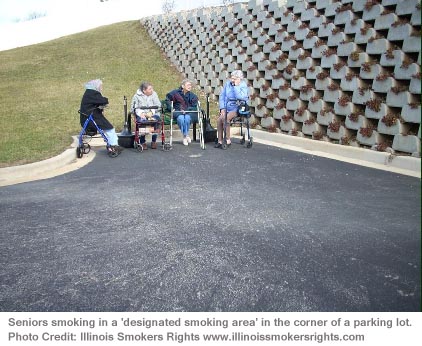
Sure, smokers do have rights, and it is not an illegal activity to smoke. In-fact, I am almost embarrassed to say (given my hard-lined stance above), that for some people, smoking is one of the few, remaining pleasures that they still have in their lives. My aunt is a perfect example. She has smoked for as Seniors forced to smoke in a parking lot at a nursing homelong as I can remember, and she has recently moved into an assisted living home in Utah. She’s tried quitting before, but we all know now that it just isn’t going to happen. She is happier when she smokes, and she deals with life better when she is able to. It’s cliche, but smoking has been one of her true, loyal friends for her entire life, and I would hate to take that away from her. She has the right to smoke – as long as it can be done without affecting the rights, and health of non-smokers.
Another consideration, especially in the case of assisted living facilities and nursing homes is the safety of the residents who are forced to go outside (at times, in inclement weather) to partake. I have seen designated smoking areas in the remote corners of parking lots, or under icy overhangs in a cold, slippery courtyard of facilities. Residents, especially those with mobility or balance problems, or compromised immune systems who are forced to spend time in these areas are put in an uncontrolled environment, which could result in injury, lawsuit, or worse.
States that allow still allow smoking in assisted living facilities have their own set of rules and guidelines about how it should be handled. Texas, for example, under Texas Administrative Code, Social Services and Assistance, Department of Aging and Disability Services – Licensing Standards for Assisted Living Facilities – Facility Construction (Title 40/Part 1/Chapter 92/Subchapter D/Rule $92.62) states:
(3) Smoking regulations must be established, and smoking areas must be designated for residents and staff. Ashtrays of noncombustible material and safe design must be provided in smoking areas.
Of course, there are numerous other rules in Texas’s Code that dictates safety, fire drills, evacuation plans, and the like – to minimize the potential dangers of smoking indoors.
However, Texas’s model creates it’s own set of possible hazards and issues. Firstly, even if there are ‘designated areas’ for smokers, how do we know that they will be used? I know enough to know that some smokers can be rebellious, and will smoke wherever they please, regardless of the rules. We have seen it, and heard about it on airplanes, in restaurants, and even in hospitals. I have seen many times the news stories of facilities that have burned to the ground, or lives that have been lost due to a resident deciding to light up in his or her room, and causing a fire from falling asleep, or not paying attention.
Nursing homes are subject to federal laws that require them to use smoke alarms and sprinkler systems. Unfortunately, assisted living facilities and group homes are not.
Another consideration for this is that smoke really knows no boundaries, especially if there is a common ventilation system. I remember living in an apartment years ago, and people often asked me if I was a smoker because my clothes always had that musty odor. I wasn’t a smoker at the time – it was my next-door neighbors, and their dirty air coming into my pace via the air ducts. I also remember seeing a designated smoking area at an assisted living facility that was outside, right next to a row of residents’ windows – all of which were open on that warm summer day. Smoke was clearly entering their rooms.
800-287-1593Pricing & Availability
Get Pricing
Dueling Banjos – Does A Facility Follow State or Local Ordinances?
Assisted Living Facilities or Nursing Homes can be caught in the middle of this debate, and the regulations imposed. I am aware of one county in Delaware that imposed a ban on smoking several years ago in all work places, which includes nursing homes, but this ban contradicted other state and federal laws. “If a nursing home bans smoking, they could lose federal funding for failing to comply with regulations, but if they allow smoking they could face fines or a lawsuit from the county health department, officials said.” See the conversation “Smoking ban raises problems for nursing homes.”
In 2007, Hanover County, North Carolina enacted a law banning smoking in assisted living facilities. “Starting Monday residents have to go outside to smoke. Rep. Justice discovered all elder-care facilities in North Carolina allowed smoking and that there was no law on the books to stop people from lighting up.” See the story “New law bans smoking in assisted living facilities.”
Again, this is a win for non-smokers, but for those smokers who have smoked all of their lives, and who live in an assisted living home – ‘What do we do with these seniors that move here, and who’ve smoked all their life, and you’re asking them to make a major life change in a addition to making a major life change.'” Rep. Justice says some assisted living administrators told her smoking helps calm down mentally ill patients. She says she wants to look into that issue further during the next session to see if the law should be modified to possibly allow those patients to smoke.”
These examples of local governments stepping in to regulate smoking touches on the bigger debate of whether we should more closely regulate the assisted living and nursing home industries on a federal level, so there is more consistency, and less confusion with regulations across the board.
Rules vs Enforcement
Really, what this whole debate comes down to at this point is that it highlights the need for individuals and families to ask very pointed questions of their facility, and to make sure they understand the rules, laws, and facility regulations regarding smoking. Since there is no clear-cut answer, and no real solutions that will satisfy everyone (smokers and non-smokers), consumers will need to take the extra time to research possible facilities that fit their lifestyle and smoking preferences.
If there are specific rules in place at a facility, they won’t do much good if there isn’t any enforcement. This means that families and individuals need to get the policy in writing, and understand what will happen if the rules are broken. If a resident is caught smoking in a non-smoking facility, will that resident be asked to move out? If a non-smoker is subject to smoke issues at a facility that claims to be smoke-free, can that resident break his or her contact or lease with the facility with no penalty?
Furthermore, if the policy or policies regarding smoking change in the future, due to newly local, state federal, or facility level initiatives, how will that affect the lease, agreements, and rights of current residents?
Taking the extra time and care up-front to understand a facility’s policies – before signing any contract, or making any decisions, will help to minimize any future issues or conflicts, and help to ensure the happiness and well-being of everyone involved. As we know, seniors are less-mobile than most of the rest of us. Any physical move that a senior is forced to make, especially when considering those suffering from dementia or memory disorders, can be extremely traumatic for both the senior, and the families who are caring for them.
Bottom Line: Know what you are getting into before you make a move for yourself, or on behalf of a loved-one. If a facility has policies on smoking or non-smoking, then they should be followed. If the rules are not being enforced, then it is the facility who is ‘blowing smoke.’
Bonnie Wrote:
I don’t condone smoking but I think smokers have human rights and should have a safe area out of the weather to smoke. Putting them out the side gate next to the flood drainage during storms is not conducive to the safety or health of smokers. Bonnie
11 January 2017 at 2:12 pm
Mary Ann Wrote:
I have my father in an assisted living facility and he shares a room with another male who was recently assigned to his room. The man is a smoker who goes out to smoke several times a day and now my father’s room smells like an ashtray after only 3 days. The facility has done nothing to protect him from this situation, so I may be forced to bring him back home. My mother and I both react strongly to SHS and THS and my father uses O2 from time to time. Fortunately he was recently approved for home services this month. I will write my state rep to support any bans for elderly facilities. Mary Ann
10 January 2017 at 12:02 pm/p>
Michael Wrote:
I live in an independent living/asst living facility in Seatttle, WA. The person in the apt below me smokes in her apt and on the balcony (which is part of the apt. This often gets cigarette smoke odor into my apt to the point that I’ve sometimes literally been smoked out of my apt. When she smokes on the balcony, I cannot enjoy my balcony. She’s had repeated letters and verbal admonitions, all of which have a very short effect, then she’s at it again. I’m told that by State law, and policy of the facility there’ to be NO smoking in any part of the building (including balconies) and that a resident who repeatedly violates these rules can be evicted. But…I am also told that a person cannot be evicted if they do not have a place lined up to go to, which means that they can violate these rules with impunity and smoke wherever and whenever they darn well please. Which leaves me denied full enjoyment of my ($87 a day) apartment and, worse, leaves me and all my fellow residents in constant danger of losing homes, property and lived from one forgotten or misplaced cigarette. There seems no solution in sight.
5 June 2016 at 1:11 pm
Hasse Wrote:
It is good that you quit the smoking and you have not been smoking for 17 years. You can inspire people who are trying to stop the smoking. Moreover, you can join our organization. we will definitely help you to quit smoking.
1 June 2016 at 8:31 am
Audrey Wrote:
A friend in a Nursing Home that allows smoking in a designated area where an aide lights the first cigarette for the patient and then returns to the inside has been given a strange order. He is not allowed to light his 2nd one from the still smoldering cigarette in the ashtray. Some times after supper there is no one around with a lighter!! Does this law make any sense? I’d like an answer for him. 252 -745-4621
10 August 2015 at 8:38 am
Marcus Wrote:
Is there any medication or treatment that will MAKE a person stop smoking? He’s mentally ill, dangerous to himself, and needs to be placed somewhere so that he can be safe. Trying to respect his autonomy would be nice, but not possible. He never has taken care of himself well, and now he’s completely unable to. 636-240-4384 .
26 June 2015 at 4:48 pm
Larry Wrote:
I wonder how Colorado’s new legalizations and legislations will affect this. I know that there are seniors who smoke the ‘other stuff’ for eye problems, pain management etc. Now that it’s legal how will assisted living homes react, or will they allow it?
3 June 2015 at 1:08 pm
Nicole Wrote:
Nothing worse than a gross facility smelling like an ashtray. Doesn’t say a lot for how they care to present themselves.
30 January 2013 at 11:05 am
Ronald Wrote:
I walked into a facility to ‘tour’ with my mother, and the overwhelming whiff of stale smoke we got turned us around immediately.
12 June 2012 at 2:25 pm
Assisted Living Directory Wrote:
It wasn’t easy for sure! I planned on quitting on New Year’s Eve of that year, and around October I started cutting back a little each day, so by the time I got there, I was at only 1 or 2 a day. Then, from the 1st through about the 10th, I took time off from work and school so I could sit at home, and sleep, and tough it out. Sleep, no-stress, and lots of snacks helped. By about the 15th of the month, I had lost the cravings. I was thrilled, and shocked. Making sure you try to quit when you are not stressed, or working, if possible, is my one big piece of advice.
10 April 2012 at 2:25 pm
Lucas Wrote:
You mention that you have been an ex-smoker for 17 years. How did you quit?
10 April 2012 at 2:21 pm
Cindy Wrote:
Banning smoking in assisted living and nursing homes will also severely limit the potential pool of employees and labor. Many of those folks are smokers too.
5 April 2012 at 9:25 am

� 2018 Assisted-Living-Directory.com

No Obligation
Assisted Living with Smoking Rules and Regulations in Assisted Living Facilities: The Debate