Memory Boxes for Assisted Living Residents

Ask A Question!
- (866) 333-6550


Don't be fooled by the Questionable Tactics used by many assisted living sites
Assisted Living Directory has a No Spam Guarantee!
Memory Boxes Help Residents With Memory Impairments or Confusion

Summary: Memory Boxes can help confused or disoriented residents to find their room or apartment, and can cut down on other behavioral issues. Our site visitors have also chimed in with some of their great tips and suggestions on how to make memory boxes!
How To Create A Memory Box Simply & Easily
Video Produced by Assisted Living Directory
Perhaps the easist way to create a memory box for an assisted living resident with Alzheimer’s or other memory impairments.
It has happened to all of us – perhaps driving around a big city, or walking through a shopping mall – the feeling of disorientation or of being lost. There is that moment that nothing looks familiar, and the feeling of confusion and helplessness sets in.
Fortunately for most of us, we eventually see a landmark, or a sign, or even an intersection that we have been to before that will help to guide us and extinguish the moment of panic or confusion.
Imagine this scenario playing out inside your home – a place that is where you likely spend most of your time. It may sound far-fetched to get lost or confused in your own home, but unfortunately, for many residents of assisted living facilities and other care environments who suffer from memory impairments such as Alzheimer’s disease, it can happen often, if not daily.
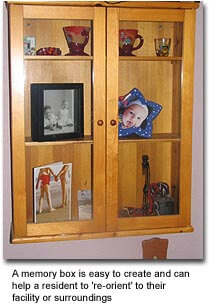
A great tool that facilities and care homes can use to help memory-impaired residents “re-orient” themselves to their surroundings, and keep them from forgetting which room or apartment is theirs – is a “memory box” or as they are sometimes called “locator boxes.”
There is nothing elaborate about a memory box, and they are fairly easy to create and implement into your home. Basically, they are a box, or display case that is placed right outside a resident’s room. Usually, these are kept at eye-level. This box is filled with items that the resident identifies with – personal items to help “jog” their memory. Items can include:
- Old photographs of family, friends, grandchildren or other loved ones
- A favorite memento
- Identification cards
- A newsletter from where they used to work
- A photo or small painting of the town that they grew up in

� 2018 Assisted-Living-Directory.com

No Obligation
Assisted Living with Memory Boxes for Assisted Living Residents