The Important Role Of A Long-Term Care Ombudsman

Summary: A Long-Term Care Ombudsman acts as a 3rd-party voice, or advocate for residents living in assisted living facilities or other Long-Term Care environments. A “LTC Ombudsman” can investigate complaints by both the resident or the facility, and help to resolve problems and issues. A Long-Term Care Ombudsman can also act as a liaison between a resident and family members.
Without any doubt, one of the strongest impressions that we get from the many questions and emails that we receive daily about assisted living and long-term care is that people are often-times lost and confused during the process of trying to place a loved-one (or themselves) into assisted living.

(Jump to “How To Locate A Long-Term Care Ombudsman“)
This is very understandable in the sense that families are often thrust into this process very quickly, without much time to be able to learn about long-term care and all of the countless variables, laws, state and federal programs that are available, questions about costs and insurance – as well as the emotional strain of making sure that mom or dad are placed into the absolute best care based on their needs, budget, and personality.
It’s can be an exhausting process for everyone involved, and the stress and confusion doesn’t always stop once placement is complete.
After The Placement – Resolving Issues And Complaints:
Unfortunately, what also frequently happens after a loved-one is placed into assisted living care is that the family, sons, or daughters go back to their own hectic and busy lives, very possibly out-of-town, state, or country.
In a perfect world, we’d like to think that mom and dad are in the best of hands, and that issues forthcoming will be nonexistent, however, chances are that things will come up that need to be addressed, and at times, serious problems or missteps by a facility may warrant further investigation by an outside person or entity.
Let’s say that dad is in an assisted living home, and his usual good-natured and cheerful disposition turns for the worst. Perhaps dad has stopped eating, and maybe there are physical signs like bruises or weight-loss that are unexplainable.
Let’s also add to that the possibility that dad has a memory disorder, like Alzheimer’s, that makes him less able to voice his concerns, or to assert himself properly.
How can a situation like this be investigated by an unbiased third-party, especially if dad’s loved-ones or family are not close by?
This Is Where A Long-Term Care Ombudsman Might Step In To Help.
This excellent video talks the essential role of our Ombudsmen, and what a ‘day in the life’ of an Ombudsman is like. Video by Florida’s Long-Term Care Ombudsman Program In essence, a long-term care ombudsman is a person, or a group of people (paid and volunteer) who act as the voice, or who advocate for residents living in nursing homes, assisted living facilities, and other care environments.
Some of the things that a LTC Ombudsman may specifically be able to do, or help you and your family with are:
- Help you to navigate the complicated process of finding assisted living, or other qualified care based on your needs
- Conflict and problem resolution. Complaints can be made by residents, or the long-term care facilities themselves
- Investigate complaints at facilities
- To educate families, consumers, as well as assisted living and long -term care providers about what their rights are, as well as what acceptable care practices and procedures are
- To offer volunteer opportunities and community involvement
- Advocate for residents’ rights
- To promote the creation of resident, family and citizen councils and organizations.
- To report findings that can be summarized in the National Ombudsman Reporting System. Data collected generally includes the number of facilities that are visited, the nature of the complaints that are filed, and the outcomes or resolutions from investigations, visits or complaints.
A Long-Term Care Ombudsman can investigate address most any issue that arises in a long-term care or assisted living facility. Commonly, Ombudsmen will investigate any violations of residents’ rights and dignity, and any physical or mental abuse, whether intentional or not. This can include inadequate care, poor nutrition, improper transfers of residents, or unacceptable conditions due to faulty heating or cooling within the facility (a common issue in the summer and winter months). Essentially, any issue or complaint generated by a resident, or a facility can be fair game for investigation.
How Do I Locate A Long-Term Care Ombudsman?
This is the easy part, and there are a number of ways to accomplish this.
What we did to find our LTC Ombudsman for our state was to simply to an internet search for ‘Long Term Care Ombudsman (and state)’ and immediately, our information came up. However, there were multiple results, and some that didn’t seem as authoritative as the one we wanted, which might be confusing to any less-than-saavy internet users.
Another great way to find your local Ombudsman is to use the Ombudsman Locator Map again on the National Long-Term Care Ombudsman Resource Center website. This is an excellent tool that offers a US map where each state may be selected, which then serves up data about Ombudsmen based on your location. There is also a handy drop-down menu that allows users to select a state as well.
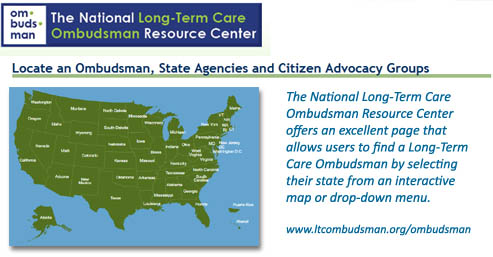
We did a test of this tool, and selected our state, and we found information for about 2 dozen Local and Regional Ombudsmen, with address and contact information. Many of them had the name of the Ombudsman for that specific area.
800-279-6671Pricing & Availability
Get Pricing
Impressive Stats!
For our state, we looked at one of the recent annual reports for the Ombudsman program, and we were impressed at the coverage and involvement that our Ombudsmen provide. For our state, we found out that our Ombudsmen:
- Consist of about 2 dozen full-time workers, assisted by over 100 part-time helpers and volunteer ombudsmen
- Our state’s ombudsmen visit every single assisted living residence at least 4 times per year
- Attended nearly 2000 residence and family council meetings, and held thousands of facility and individual consultations.
- Conducted hundreds of volunteer training sessions and training sessions for the staff and workers at long-term care and assisted living facilities.
Your Involvement Matters!
If you have a family member living in a long-term care environment, or assisted living, the best thing that you can do to ensure their well-being during the course of their stay is to visit the facility often, and to ask plenty of questions about the care your loved-one is receiving. Even if you live out of state, do not assume that a facility is going to tell you everything you need to know, or that they will report abuse, mistreatment, or substandard care.
The more that families show interest in a facility through visits and check-ins, the more the facility is likely to “stay on their toes” when it comes to quality of care, cleanliness, staff professionalism, and all other aspects of operating the facility.
In addition, we recommend that families learn who their Ombudsman is, or is likely to be, and check in with him or her periodically. If a facility has a track record of shortcomings or negligence, or if there are any changes (for better or for worse) happening at a facility, they will very likely know about it, and will most certainly share that information with you.
Lastly, if you suspect anything that is questionable at your family member’s facility, bring it to the facility’s attention immediately. If a resolution is not quick and effective, we recommend having an Ombudsman investigate the situation.
Ensuring the best, most ethical and professional care for those who we love is a collaborate, ongoing effort!

� 2018 Assisted-Living-Directory.com

No Obligation
Assisted Living with The Important Role Of A Long-Term Care Ombudsman